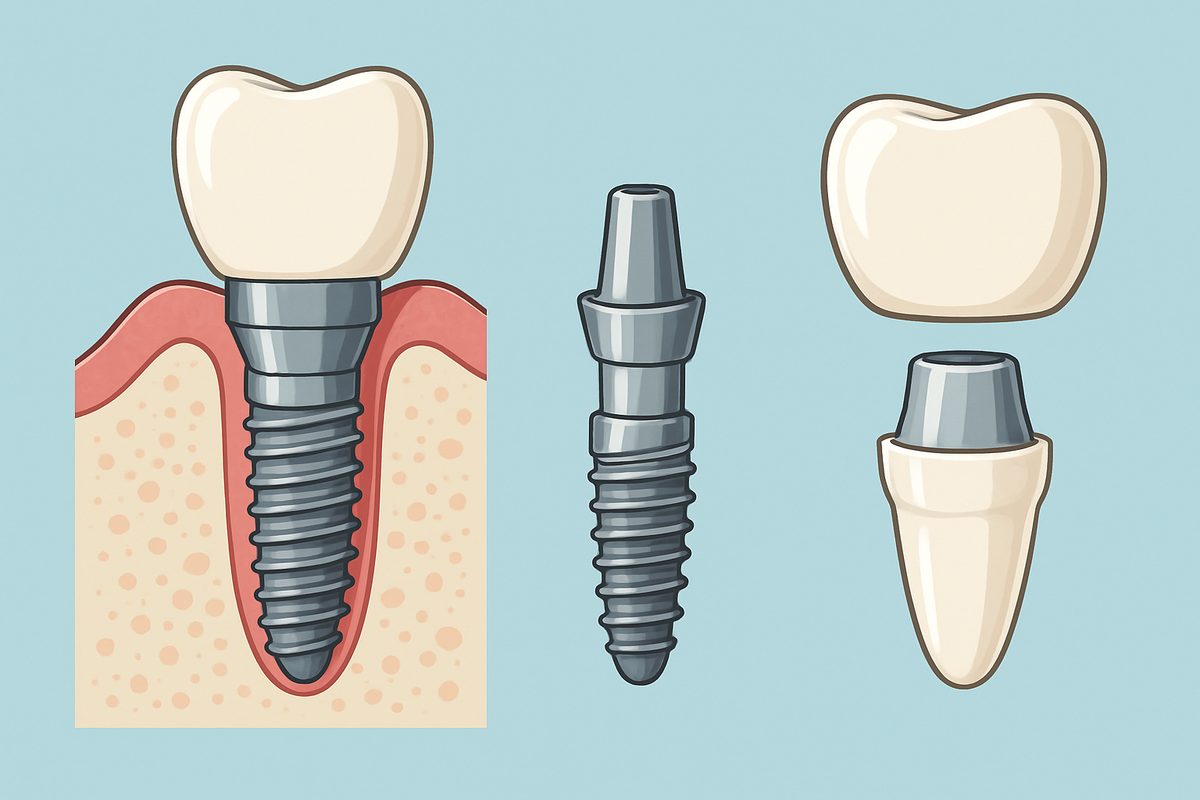
Many people ask, “What do dental implants look like?” This post separates fact from fiction and explains the parts of an implant, how implants appear at different stages, what affects their appearance, and when to talk to a dentist. Want to know what an implant look like in The Villages, FL? Read on for clear, practical answers and next steps.
This guide is for anyone considering implants or wanting to understand treatment visuals — from the metal post to the finished tooth-like crown. You’ll learn what to expect during healing, how labs match color and shape, and smart questions to bring to a consult.
What an implant look like: the three main parts
The implant post (the root)
The implant post is a screw made of titanium or zirconia that is placed into the jawbone. It acts like a tooth root and gives the restoration strength and stability. Once the area heals and the bone fuses to the post (osseointegration), the post is buried under the gum and is not visible. The post’s shape and size matter because they affect support and how well the final tooth sits in the mouth.
The abutment (the connector)
The abutment is a small connector that joins the implant post to the crown. It can be made of titanium, zirconia, or a hybrid material. You might see the abutment during the healing phase or when a temporary is attached, but with a finished restoration the abutment is usually hidden under the crown or at the gum line where it’s carefully contoured to look natural.
The crown or prosthesis (the visible tooth)
The crown is the visible part that looks like a tooth. Crowns and prostheses can be made from porcelain, ceramic, or hybrid materials. Technicians match color, shape, and surface texture to nearby teeth so the implant blends in. High-quality crowns mimic tooth translucency and tiny surface details that make them look natural.
How an implant looks during treatment vs. after final restoration
During treatment you may see a healing cap, temporary crown, or small gaps while tissues settle. Temporaries protect the site and help shape the gum, but they can look different from the final tooth. After the final restoration is placed, the crown is designed to match surrounding teeth so it blends in for everyday function and appearance.
Common myths vs. facts about how implants appear
- Myth: Implants look metallic or fake. Fact: The finished crown is tooth-colored and made to mimic natural teeth.
- Myth: Implants always stand out from natural teeth. Fact: With careful shade matching and lab work, implants can be indistinguishable from real teeth.
- Myth: You’ll always see metal near the gum. Fact: Modern materials and proper planning usually hide metal; zirconia options remove metal visibility entirely.
Factors that change how an implant looks
Gum and bone health
Healthy gums and good bone support are essential for a natural look. Gum recession or bone loss can expose the implant edges or abutment, making the restoration less esthetic. Sometimes grafting or soft-tissue procedures are needed to create the proper contour.
Material and shade selection
Crown materials differ in translucency and color. Porcelain layered over a core can mimic natural depth, while zirconia offers strength and a clean base for bright smiles. Shade selection must match neighboring teeth under real light — a poor match makes restorations obvious.
Lab skill and digital planning
High-quality labs and precise digital planning (CBCT scans, digital impressions, and 3D guides) improve fit and esthetics. Skilled technicians shape anatomy, texture, and color to mimic natural teeth. Poor lab work or limited planning often shows in the final result.
How to evaluate before-and-after photos and what to ask your dentist
- Ask if photos show finished restorations or temporaries.
- Request close-up shots from multiple angles and real patient cases.
- Ask what materials and shade systems were used.
- Request a digital mockup or try-in so you can preview the expected result.
Maintaining the look: care and expectations
Maintain implants like natural teeth: brush twice daily, floss or use interdental cleaners, avoid excessive staining foods or tobacco, and keep regular dental checkups. With good care, crowns can last many years, but occasional touch-ups or replacement may be needed for wear or color change.
About Sumter Landing Dental Care and next steps
Sumter Landing Dental Care in The Villages, FL offers implant care using CBCT imaging, an in-house dental lab, and 3D printing to plan and deliver natural-looking results. Dr. David Price and Dr. Anil Patel bring decades of experience and advanced training to implant and restorative cases, with options for single implants, full-mouth reconstructions, and same- or next-day restorations.
If you want to see real patient photos and digital previews of what your implant could look like, schedule a consult to review images, material options, and a customized plan.